Musk’s Biggest Play Yet: The IPO Heard Round the World
In financial history, IPOs, or initial public offerings, have been seen as fundraising events. Companies go public primarily to raise capital to sustain operations and grow. Most times, you don’t hear about the ins and outs of the process of a company going public. However, for Elon Musk’s SpaceX, that is far from the truth. SpaceX is preparing for something categorically different this June – unlike anything we have ever seen before. SpaceX going public is more than just an IPO – it is a monetization of a vision for Musk. It is an attempt to build an empire.
First, let’s break down the numbers, which are staggering in their own right. SpaceX has filed with the Securities and Exchange Commission, or SEC, targeting a valuation of $1.75 trillion and aiming to raise around $75 billion in what would be the largest IPO in history. {¹} For context, that would be three times the record to date – Saudi Aramco, which raised $25.6 billion in 2019*. {²}
When most people think of SpaceX, they think of the company that sends rockets into space and around the Earth. While this is true, with SpaceX conducting 165 orbital flights in 2025, accounting for more than half of all launches worldwide {²}, the real prize is Starlink .
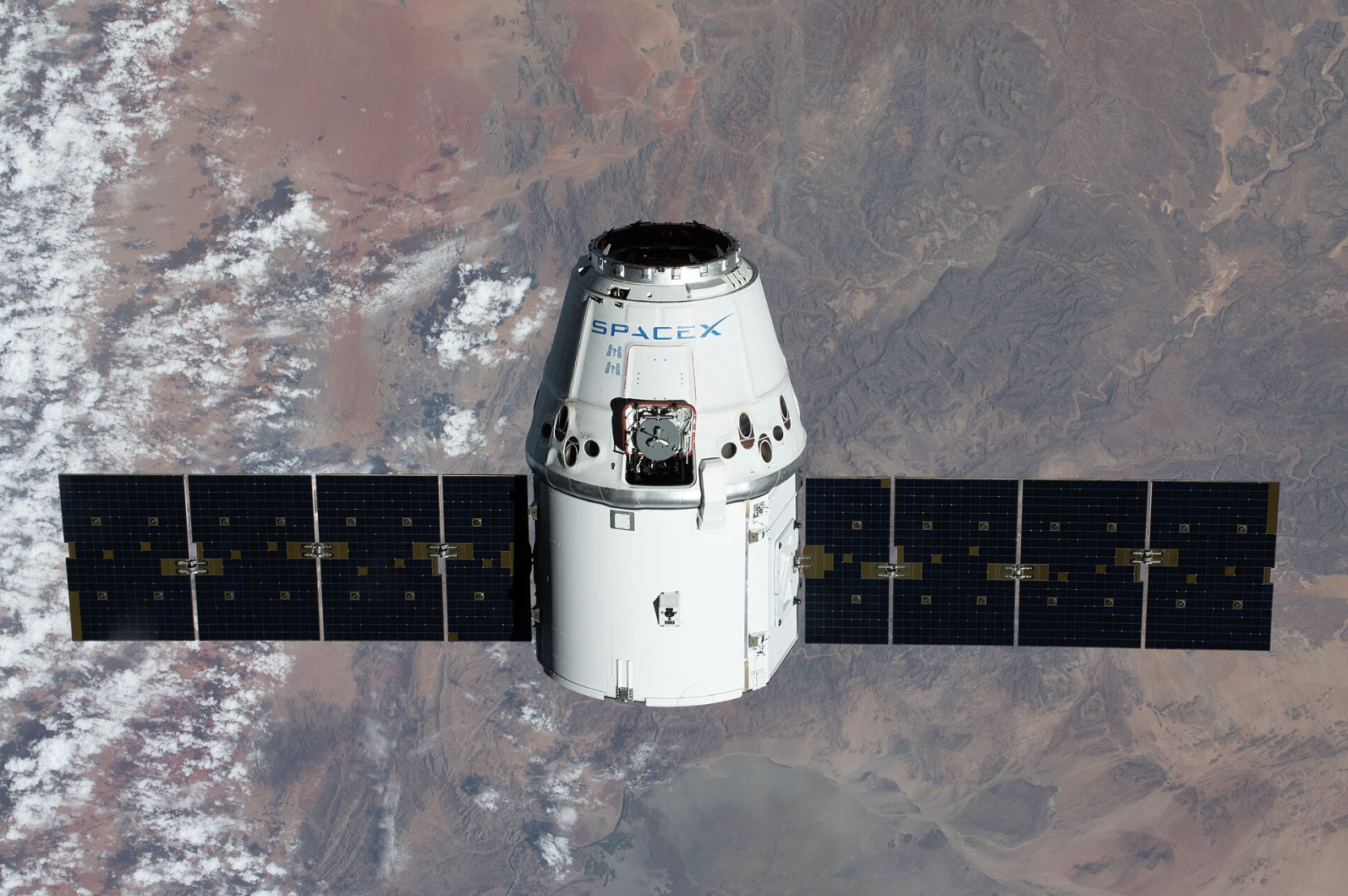
SpaceX Dragon Resupply Ship pictured approaching the International Space Station
While the official name is Space Exploration Technologies Corporation, Musk’s soon-to-be-public corporation comprises SpaceX, the Starlink satellite network, and xAI. Starlink is an internet service provider to more than 150 countries that utilizes low Earth orbit satellites. {³} xAI is Musk’s AI startup whose most well-known product is Grok. {⁴}
So why is Starlink the true prize of the corporation? Without Starlink, SpaceX would still just be a remarkable space launch company. However, with Starlink, the company is beginning to look like a global telecommunications powerhouse with a hold over the ever-growing space industry.
Elon Musk is trying to gain a hold of an entire industry through vertical integration, with him at the helm of the entire operation. Musk is perfectly setting up a plan to create a new space industry: satellite-based internet providers, AI data centers in space, and a new degree of space exploration. This will all be achieved through the overarching company of SpaceX.
With Musk already having an established internet provider and infrastructure in Starlink, he can use SpaceX's rockets to launch them into low Earth orbit. On top of that, he will be able to use his already established xAI to build solar-powered AI data centers in space, which will then be transmitted down to Earth through Starlink. And, you guessed it, those AI data centers are getting to space by way of SpaceX Starship rockets.
What most people don’t see with this plan is that Musk is going beyond the internet and AI. With Musk as Tesla's largest individual shareholder, he is setting up the biggest merger of all time. Once SpaceX goes public, Musk could merge it with Tesla, forming one large, consolidated corporation that would dominate the space industry.
If SpaceX merged with Tesla, Musk could push space exploration into areas humankind has never seen before. Musk has already discussed using Starship rockets to transport Tesla’s Optimus humanoid robots to the moon and Mars. This would put human-like robots on Mars, bringing humankind closer to reaching it. SpaceX is also planning a dual-class share structure that would preserve Musk's voting control post-IPO – raising governance questions that public-market investors will have to weigh carefully. {⁵}
The most noteworthy expression of Musk’s consolidation vision came in late March 2026 with the announcement of TeraFab, a $20-25 billion semiconductor mega-facility jointly developed by Tesla, SpaceX, and xAI. {⁶} The goal for Musk is to produce more than one terawatt of AI compute capacity per year, consolidating chip design, fabrication, memory production, and packaging under a single roof. {⁶} Intel has also officially joined the project, offering Musk its expertise in the field. The chips produced at TeraFab would power Tesla’s autonomous vehicles, Optimus robots, and SpaceX’s planned constellation of data center satellites in low Earth orbit. {⁶}
This could give an unprecedented amount of power to a single person, which should concern everyone. Elon Musk would successfully control a dominant launch provider, the largest satellite internet constellation, a leading AI company, a humanoid robotics program, and the primary chip supplier for all of the above. If that is not power, I don’t know what is.
That said, a Tesla-SpaceX merger would most likely face significant regulatory hurdles before anything is official. All of this is very preliminary, but real. With SpaceX’s IPO in June of 2026, who knows when a merger could happen.
What is certain is that the SpaceX IPO is not, at its core, about going public. It is about going further – faster, with more capital, and with every piece of the industrial stack pointed in the same direction. It is a new chapter of innovation. June 2026 is the starting gun, not the finish line.
*Saudi Aramco is listed on Saudi Stock Exchange, while Alibaba is largest IPO in US history on the NYSE to date
